Halliday & Matthiessen (2014: 726, 727):
Let us round off the discussion of types by showing an analysis that relates the metaphorical and congruent versions of an example through a series of steps: see Figure 10-16.
Halliday & Matthiessen (2014: 726, 727):
Let us round off the discussion of types by showing an analysis that relates the metaphorical and congruent versions of an example through a series of steps: see Figure 10-16.
Halliday & Matthiessen (2014: 725, 726):
When the realisation of a whole figure is downgraded through metaphor from clause to nominal group, its elements will, of course, also be downgraded: the process is nominalised and serves as Thing (except in the case of a qualitative attributive relational clause, where it is the Attribute that is reconstrued as Thing, as noted above); the other elements of the figure are realised either as downranked groups/phrases serving as Qualifier or Deictic (instead of as ranking ones, serving in a clause) or, by a further step, as words serving as Classifier, Epithet or post-Deictic. For example, my original intention in my original intention was to write a saga covering three generations of the Okonkwo family in one book is structured as Deictic ^ Post-Deictic ^ Thing, corresponding to the congruent clause Subject ^ Adjunct ^ Predicator: see Figure 10-15.
Relations of internal cause – cause in the sense of ‘x so I think/say y’ – are construed metaphorically by verbs of proving such as prove, show, demonstrate, argue, suggest, indicate, imply in ‘intensive identifying relational’ clauses:
||| The wide range of potential contributions by the RC has proven to be a bright spot || as we strive to match available resources to a demanding mission load, || and demonstrates clearly the enduring value and relevance of the citizen-soldier. |||
||| Further experiments proved [[[ that the dye lowered fertility in rats, || induced still-births || and even produced malformed and macerated foetuses]]] . |||
||| Large amounts of feldspar in a sandstone may imply rapid deposition and burial [[ before chemical weathering could decompose the feldspar]] , || or it might imply a cold climate [[ in which chemical weathering is very slow]] . |||
The possibilities of downgrading include the four types set out in Table 10-12.
In the congruent mode, a sequence of two figures is realised by a nexus of two clauses; but in the metaphorical mode, the domain of realisation is downgraded from clause nexus to clause. In the metaphorical mode, the domain of realisation of either one or both of the figures is, in turn, downranked from clause to group/phrase. These successive steps in downgrading are possible because, as we have seen, both projection and expansion are motifs that are manifested throughout the grammatical system: a sequence of projection can thus be realised not only by the manifestation of projection in the clause nexus, but also by its manifestation in the clause or the group/phrase. The same principle applies to expansion.
In our presentation of interpersonal metaphor, we identified a number of common types. The general tendency is for interpersonal metaphor to ‘upgrade’ the domain of grammatical realisation; for example, while the congruent realisation of modality is a group serving in the clause, the metaphorical realisation is a clause that projects (I think ... , etc.) or embeds (it is probable ... , etc.) the clause to which a modal value is assigned. In this way, interpersonal metaphor tends to expand interpersonal systems by adding explicit variants – that is, variants where the subjective or objective orientation is made explicit.
In contrast, the general tendency for ideational metaphor is to ‘downgrade’ the domain of grammatical realisation of a semantic sequence, figure or element – from clause nexus to clause, from clause to group/phrase, and even from group/phase to word. Such downgrading affects both the unit whose domain of realisation is downgraded, and the units of which it is composed: the downgrading proceeds down the rank scale by a kind of ‘domino effect’. The downgrading may start with (i) a whole sequence of figures, (ii) with a single figure, or (iii) with a single element within a figure.
As we have seen, grammatical metaphor of the ideational kind is primarily a strategy enabling us to transform our experience of the world: the model of experience construed in the congruent mode is reconstrued in the metaphorical mode, creating a model that is further removed from our everyday experience – but which has made modern science possible. At the same time, there are also textual and interpersonal consequences of this metaphorical realignment in the grammar: ideational metaphor can be a powerful textual resource for managing the creation of text, creating new mappings between the ideational and textual quanta of information; and it can also be a powerful interpersonal resource for organising the ongoing negotiation of meaning, creating new mappings between the ideational and interpersonal propositions/proposals.
By the same token, when a figure is realised metaphorically by a group or phrase, it is deprived of the interpersonal status of a proposition or proposal, making it inarguable. It is thus presented as something already established; and any modifications, including interpersonal evaluative ones, have to be taken for granted:
A standard empirical hypothesis is that one component of the mind/brain is a parser, which assigns a percept to a signal (abstracting from other circumstances relevant to interpretation). [Chomsky, 1995, The minimalist program. Cambridge, Mass.: The MIT Press, p.18.]Any serious approach to complex phenomena involves innumerable idealisations, and the one just sketched is no exception. [Chomsky, The minimalist program, p.19.]But interesting (and conflicting) arguments have been presented. [Chomsky, The minimalist program, p. 22.]Much of the fruitful inquiry into generative grammar in the past years has pursued the working hypothesis that UG is a simple and elegant theory, with fundamental principles that have an intuitive character and broad generality. [Chomsky, The minimalist program, p. 29.]
… ideational metaphor also realigns the ideational in relation to the interpersonal. When a sequence is realised metaphorically by a clause, it is given the interpersonal status of a proposition or proposal, making it arguable. For example:
||| Too many unprogrammed deployments will inevitably disrupt operating budgets, || sap morale, || cause lost training opportunities, || and accelerate wear and tear on equipment. |||
||| A magnitude-6 quake can cause severe damage || if it is centred under a populated area. |||
||| This is consistent with the concept [[ that the antarctic ozone hole phenomenon causes a dilution effect throughout much of the Southern Hemisphere]] . |||
As the examples illustrate, a ‘propositionalised’ sequence can be modalised, doubted, argued and negotiated interpersonally in numerous other ways.
To sum up: when a sequence is realised by a clause rather than by a clause nexus, it will be structured textually into Theme + Rheme and, since a clause is an information unit in the unmarked case, also into Given + New. This means that the figures that make up the sequence can be given thematic or newsworthy status. In addition, such a figure, realised metaphorically by a nominal group rather than congruently by a clause, gains access to the textual systems of the nominal group – most significantly, the system of DETERMINATION. This means that it can be treated textually as a discourse referent. It is marked either as ‘non-specific’ or as ‘specific’, in which case its identity is presented as recoverable to the addressee.
When a sequence is realised metaphorically by a clause, this means not only that it is mapped onto the transitivity patterns of the clause but also that it falls within the domain of the Theme + Rheme organisation of the clause and also, by extension, that of the Given + New organisation of the information unit. Thus the following sequence –
Displacement along these faults caused failure of the Baldwin Hills Reservoir in 1963
– is realised metaphorically as a ‘relational’ clause, and the figures making up the sequence are realised metaphorically as nominal groups serving as elements of the clause. Since they function within the clause, these nominal groups can be assigned textual statuses: the nominal group displacement along these faults serves as Theme, and the nominal group failure of the Baldwin Hills Reservoir in 1963 serves as New: see Figure 10-12. The metaphoric ‘relational’ clause thus creates a textual pattern of Theme: figure ‘displacement’ + New: figure ‘failure’.
This textual patterns is an effective resource in the rhetorical development of scientific discourse (see Halliday, 1988; Halliday & Martin, 1993). There is thus a gain in textual meaning in the shift from the congruent mode of realisation to the metaphoric mode. In this way, the ideational metaphor accommodates the textual metafunction: the experiential configuration of Identified + Process + Identifier structures the sequence into two textual quanta, one figure as Theme followed by another as New. In some cases, this kind of textual accommodation may be the main reason behind the ideational metaphor.
Within the ideational metafunction, the general effect of this realignment in the semantic system is a shift from the logical to the experiential – an experientialisation of our construal of experience (see Halliday & Matthiessen, 1999: 264). Thus logical sequences of figures are reconstrued as experiential configurations of elements. But the significance of grammatical metaphor of the ideational kind extends beyond the ideational metafunction to both the textual and interpersonal ones. The textual and interpersonal effects of ideational metaphor are due to the fact the realignment of ideational patterns described above also means that there is a realignment of the textual and interpersonal environments in which ideational systems operate.
… the metaphorical mode thus makes available a great deal of further ideational potential that is not accessible in the congruent mode. At the same time, the metaphorical mode also denies access to significant aspects of the potential that is associated with the congruent mode: there is a loss of ideational meaning. For example, the tactic patterns of clause complexing (with the distinction between paratactic interdependency and hypotactic dependency) are not available to sequences that are realised metaphorically as clauses, and the configurational patterns of participant roles are lost or obscured when figures are realised as groups or phrases. Thus in the nominal group the perception of an inadequate retirement program, it is likely that an inadequate retirement program is what is perceived, but this has to be inferred (contrast the perception of concerned citizens, where concerned citizens is likely to be the perceiver, not what is perceived); and the perceiver is left implicit. In more congruent versions, such underspecification does not occur: people see the retirement program as inadequate, people think that the retirement program is inadequate, and so on. This is because the grammar of the clause construes participants as inherent in the process, and only allows them to be absent through ellipsis if they are recoverable.
As we have seen, the ideational metafunction is a resource for construing our experience of the world that lies around us and inside us. In the congruent mode, the grammar construes sequences (of figures), figures and elements as the basic phenomena of experience. In the metaphorical mode, the model is enriched through combinations of these categories: in addition to the congruent categories, we now also have metaphorical combinations of categories – sequences construed as figures, figures construed as elements, and so on. These combinations open up new meaning potential. For example, in a sequence, there is a temporally invariant logico-semantic relation such as cause, but in a sequence construed as a figure, this relation is typically construed as a process. Unlike a logical relation, a process is construed as unfolding through time, and in the grammar of the verbal group it is marked for tense or modality.
The ‘re-mapping’ is possible because semantic motifs such as cause are manifested repeatedly in the different environments of the grammar so that each environment is a possible domain of realisation for such a motif. These motifs are of the two primary types, expansion and projection. Ideational metaphor is based on patterns that exist already in the congruent mode of realisation; but it expands these patterns significantly, as can be seen when we analyse scientific, legal or administrative discourse – or, indeed, other kinds of discourse that the metaphorical mode has spread to in a systematic way.
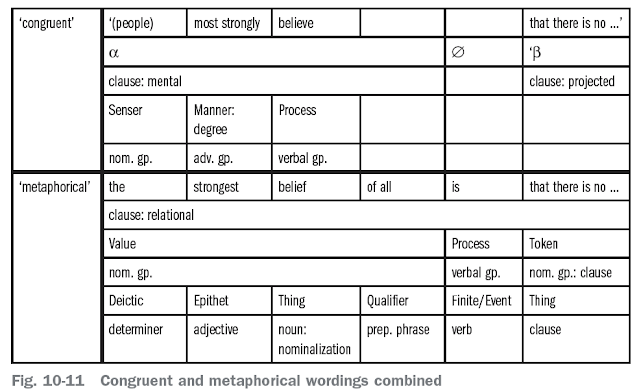
As illustrated by the example analysed in Figure 10-11, grammatical metaphor within the ideational metafunction involves a ‘re-mapping’ between sequences, figures and elements in the semantics and clause nexuses, clauses and groups in the grammar. In the congruent mode of realisation that we described in Chapters 5 and 7, a sequence is realised by a clause nexus and a figure is realised by a clause. In the metaphorical mode, the whole set of mappings seems to be shifted ‘downwards’: a sequence is realised by a clause, a figure is realised by a group, and an element is realised by a word. The two modes of realisation are contrasted diagrammatically in Figure 10-14 below.

Consider the following steps in the text:(a) Most linguists today believe that there is no good evidence ...(b) the strongest belief of all is [[ that there is no trace ... ]]… a projection sequence of figures in the semantics is realised congruently by a projection clause nexus in the grammar, and the two figures forming the sequence are realised by clauses. This is what we find in example (a); but in (b), a projection sequence has been realised not by a clause nexus but by a simple clause, and the figure of sensing is realised not by a clause but by a nominal group, while the projected figure has been realised not by a dependent ‘idea’ clause but by an embedded ‘fact’ clause. The congruent and metaphorical modes of realisation are combined in Figure 10-11. Just like interpersonal metaphor, ideational metaphor introduces additional layers of meaning that are construed by the grammar as additional layers of wording. …
Unlike interpersonal metaphor, the other type of grammatical metaphor, ideational metaphor, is learned later by children and is not part of the grammar of ordinary, spontaneous conversation that children meet in the home and neighbourhood; rather, it is associated with the discourses of education and science, bureaucracy and the law. Children are likely to meet the ideational type of metaphor when they reach the upper levels of primary school (see e.g. Christie & Derewianka, 2008; Derewianka, 1995); but its full force will only appear when they begin to grapple with the specialised discourses of subject-based secondary education.
The interpersonal metafunction defines the environment in which children first learn the strategy of grammatical metaphor. No doubt this is partly because interpersonal metaphors tend to make selections more explicit, as when probability is realised by a ‘mental’ clause projecting the modalised proposition (‘explicit’ orientation), and partly because the interpretation of interpersonal metaphors is often both supported and ‘tested’ immediately in the ongoing dialogic interaction. For example:
Oh. Stefan, can you turn off the tape? – [Non-verbal response: tape is turned off.]
Here the responses show that the ‘yes/no interrogative’ clauses are interpreted as metaphorically realised commands rather than as congruently realised questions. The expansion of the interpersonal semantic system through grammatical metaphor provides speakers with additional, powerful resources for enacting social roles and relations in the complex network of relations that make up the fabric of a community of any kind.
We have explored certain key strategies involved in the metaphorical expansion of the interpersonal meaning potential, showing that they are not random or ad hoc features of the system but rather motivated and principled extensions of the congruent system. There are, of course, other strategies as well. The lexicogrammatical resources of MOOD, and the associated patterns of MODALITY and KEY, carry a very considerable semantic load as the expression of interpersonal rhetoric. Not surprisingly, these categories lend themselves to a rich variety of metaphorical devices; and it is by no means easy to decide what are metaphorical and what are congruent forms. Some common speech-functional formulae are clearly metaphorical in origin, for example
(i) I wouldn’t ... if I was you: command, congruently don’t ... ! functioning as warning;(ii) I’ve a good mind to ... : modalised offer, congruently maybe I’ll ..., typically functioning as threat;(iii) she’d better ... : modulated command, congruently she should ... , typically functioning as advice.
Some words, such as mind, seem particularly to lend themselves to this kind of transference: cf. would you mind ... ?, mind you!, I don’t mind ... (including I don’t mind if I do, positive response to offer of drink in the environment of a pub), and so on.
The ‘indicative’ realisation of proposals has the effect of blurring the line between proposals directed to the addressee and propositions about how the world ought to be. For example, through the extension of you from ‘addressee’ to ‘generalised person, including the addressee’ (in contrast with generalised they), we get general rules, general advice, and the like:||| If you find [[ yourself coming back the next day || and erasing more of the so-called improvements [[ than you keep]] ]], || you’d better get the hell out of that book. |||
||| If you are writing about something [[ that you have not experienced]] , || then you must supply yourself with experience. |||
||| You cannot drink on the job. |||
In addition to metaphors based on ideational projection, there are other kinds of metaphor of mood as well. One prominent type involves a shift in the realisational domain of commands from ‘imperative’ to ‘indicative’ clauses. The ‘indicative’ clause can be either ‘declarative’ or ‘interrogative’; for example:
[iii] proposal ↘ modulated indicative
(1) declarative||| Yes, well, if you apply that criterion, || then surely you must start to rearrange your estimates of Lawrence’s novels, surely. |||||| Perhaps you should tell me about your current project. |||||| You just don’t think about it; || you shouldn’t. |||||| Well look, honestly, Mrs Finney, my suggestion to you would be [[[ that if you want to read English honours || you should spend a year in solid preparation for it || and then reapply]]] . |||||| I think || you should talk to David Hawker, || whose committee, <<I think,>> put this in train. |||(2) interrogative||| Oh can you get some napkins? |||||| Can you name a moment, or an image [[[ that you can point to || and say || this is [[ when you decided || that you were going to write The Greenlanders]] ]]] ? |||||| Would you like to take the comfortable chair? |||||| Could you tell us about a poem [[ which lives up to this ideal of yours]] in whatever period? |||
As we have noted, metaphors of mood make it possible for the semantic system of SPEECH FUNCTION to be further elaborated in delicacy. Why does the speech functional system need to be expanded in this way? The basic principle is this: the expansion of the speech functional system has increased the meaning potential available to interactants for negotiation in dialogue. …
The potential for negotiation in dialogue created by metaphors of mood is directly related to the different contextual variables within tenor. Metaphors of mood expand the interpersonal resources for negotiation, whether the negotiation involves consensus or conflict. The tenor variables are usually discussed in terms of status, formality, face, tact and politeness (and their negative counterparts). What these have in common is a very general sense of the social distance between the speaker and the addressee. Here interpersonal metaphor is part of a principle of interpersonal iconicity: metaphorical variants create a greater semiotic distance between meaning and wording, and this enacts a greater social distance between speaker and addressee. The semiotic distance is often manifested directly in the lexicogrammar as a syntagmatic extension of the wording.
In the type of mood metaphor shown in Table 10-11, the proposition/proposal is realised by a clause nexus of projection rather than by a simple clause. The interpersonal projection embodied in speech function has thus been realised as if it was an ideational projection. This has two consequences for the expansions of the meaning potential of speech function, just as in the case of modality. On the one hand, the option of making the subjective orientation of the speech functional selection explicit is added to the system, as in vote against ... (implicit) vs. I urge you to vote against (explicit). On the other hand, the speech functional system can be further elaborated in delicacy by drawing on the extensive resources of the lexicogrammar of ‘verbal’ and ‘mental’ clauses. Thus in addition to vote against ..., we now have, for example, (‘verbal’) I tell you/command you/order you/ask you/urge you/implore you/ beseech you/plead with you/suggest to you → to vote against ...; (‘mental’) I want/desire/‘d like/ intend/plan → (for) you to vote against .... And while these clauses are constrained in terms of SUBJECT PERSON and DEICTICITY, they still allow for additional systemic variation; for example: I urge you/I would urge you/I should urge you/I must urge you//can I (please) urge you/could I perhaps urge you → to vote against ....
In the realm of propositions, the line between explicitly objective propositions and modal assessment seems to disappear. Forms such as it is said that, it is rumoured that serve as assessments of the nature of the evidence for a proposition: it is, as it were, represented as being projected by somebody other than the speaker (thus it is said and they say are very close in meaning); the projection thus serves as a device enabling speakers to distance themselves from the proposition. For example:
||| Of Samuel it is said || that when he asked the people || to bear witness || that he had not taken anything of theirs || the people said || that they were witnesses. |||||| It is said || that television keeps people at home. ||| But you, at any rate, have proved that wrong. ||| And they say, too, || that television makes its appeal to those of lesser intelligence. |||||| Furthermore, it is claimed, || there are no known connections between the languages of the Old World and those of the Americas. |||
The command ‘vote against ...’ is realised metaphorically by a hypotactic clause nexus; it is realised as if it was a report of what the speaker says. This is just like the metaphorical realisation of modality of the explicitly subjective orientation. Thus the reported command can be tagged: I urge you to vote against ... will you? In other words, just like modality, speech function can be represented as a substantive proposition in its own right; and this proposition is a figure of sensing or saying that projects the original [i] proposal or [ii] proposition.
But the notion of interpersonal projection is not, in fact, limited to modal assessment. Consider the short persuasive text in Text 10-5:
Text 10-5: Exploring – arguing: open letter appealing to members of an organisation [Text 6]
I don’t believe that endorsing the Nuclear Freeze initiative is the right step for California Common Cause. Tempting as it may be, we shouldn’t embrace every popular issue that comes along. When we do so we use precious limited resources where other players with superior resources are already doing an adequate job. Rather, I think we will be stronger and more effective if we stick to those issues of governmental structure and process, broadly defined, that have formed the core of our agenda for years. Open government, campaign finance reform, and fighting the special interests and big money – these are our kinds of issues.
Let’s be clear: I personally favour the initiative and ardently support disarmament negotiations to reduce the risk of war. But I don’t think endorsing a specific freeze proposal is appropriate for CCC. We should limit our involvement in defence and weaponry to matters of process, such as exposing the weapons industry’s influence on the political process. Therefore, I urge you to vote against a CCC endorsement of the nuclear freeze initiative.
Expressions of modulation are bolded and expressions of modalisation are italicised; metaphorical expressions are underlined. Subjective assessment of modality permeates the text, like a prosody. In the case of modalisation, it is largely explicit; in the case of modulation, it is implicit until the very last clause. This clause realises the nucleus of the whole text; it is here that the key proposal is presented with a nuclear punch… .
But what is the key proposal? One variant of I urge you to vote ... is you must vote ..., the two being relatable as explicit and implicit variants of subjective, high modulations of the type obligation. However, we can take one step further in the analysis. What the author is saying is Vote against ..., which is an ‘imperative’ clause – the congruent realisation of a proposal of the subtype ‘command’. This indicates the connection between ‘imperative’ clauses and modulation, which is why modulation was characterised as the ‘imperative type’ of modality. On the one hand, an ‘imperative’ clause imposes an obligation; on the other hand, the imperative tag checks the addressee’s inclination to comply (will you?). But the example also illustrates the connection between mood and projection.
There is thus a fundamental relationship between modal assessment, including modality, and projection. To bring this out, we can interpret modal assessment as interpersonal projection. Interpersonal projection always involves the speaker or addressee as ‘projector’: ‘I think’, ‘I say’; ‘do you think’, ‘do you say’. It is always implicit unless it is made explicit through grammatical metaphor, by ‘co-opting’ ideational resources to do interpersonal service.
This is the general effect of grammatical metaphor: it construes additional layers of meaning and wording. To capture this layering in our grammatical analysis, we introduce one or more additional structural layers in the box diagram. The representation of grammatical metaphor in such diagrams shows how the metaphor is embodied in the structural organisation as an increase in the layers of meaning and wording.
But there is, of course, also a systemic effect. Systemically, metaphor leads to an expansion of the meaning potential: by creating new patterns of structural realisation, it opens up new systemic domains of meaning. And it is the pressure to expand the meaning potential that in fact lies behind the development of metaphorical modes of meaning. Thus in the system of MODALITY, the system of ORIENTATION is expanded by the addition of a systemic contrast in MANIFESTATION between ‘explicit’ and ‘implicit’: the metaphorical modalities described above make it possible to make the orientation explicit in wordings such as I think and it is likely that, which, in turn, makes it possible to increase the delicacy of differentiations (cf. I think/imagine/expect/assume/suppose/reckon/guess; I would think/I would have thought; I imagine/I can imagine; and so on).
As we have already seen, this same principle extends beyond modality and applies to modal assessment more generally (e.g. I regret, it is regrettable that). The metaphoric strategy is to upgrade the interpersonal assessment from group rank to clause rank – from an adverbial group or prepositional phrase serving within a simple clause to a clause serving within a clause nexus of projection.
As we have seen, the semantic domain of modality is extended through grammatical metaphor to include explicit indications of subjective and objective orientation: a modal proposition or proposal is realised, as if it was a projection sequence, by a nexus of two clauses, or as if it was a fact embedded as a Carrier in a relational clause with a modal Attribute, rather than by a single clause. Here the modal assessment itself is given the status of a proposition in its own right; but because the projecting clause of the nexus is metaphorical in nature, standing for an interpersonal assessment of modality, it is also, at the same time, a modal Adjunct in the clause realising the proposition/proposal.
Figure 10-9 gives a further example, containing both an interpersonal metaphor and one of an ideational kind.
The importance of modal features in the grammar of interpersonal exchanges lies in an apparent paradox on which the entire system rests – the fact that we only say we are certain when we are not. If unconsciously I consider it certain that Mary has left, I say, simply, Mary’s left. If I add a high value probability, of whatever orientation, such as Mary’s certainly left, I’m certain Mary’s left, Mary must have left, this means that I am admitting an element of doubt – which I may then try to conceal by objectifying the expression of certainty. Hence whereas the subjective metaphors, which state clearly ‘this is how I see it’, take on all values (I’m sure, I think, I don’t believe, I doubt, etc.), most of the objectifying metaphors express a ‘high’ value probability or obligation – that is, they are different ways of claiming objective certainty or necessity for something that is in fact a matter of opinion. Most of the ‘games people play’ in the daily round of interpersonal skirmishing involve metaphors of this objectifying kind.
The explicitly subjective and explicitly objective forms of modality are all strictly speaking metaphorical, since all of them represent the modality as being the substantive proposition. Modality represents the speaker’s angle, either on the validity of the assertion or on the rights and wrongs of the proposal; in its congruent form, it is an adjunct to a proposition rather than a proposition in its own right. Speakers being what we are, however, we like to give prominence to our own point of view; and the most effective way of doing that is to dress it up as if it was this that constituted the assertion (‘explicit’ I think ... ) – with the further possibility of making it appear as if it was not our point of view at all (‘explicit objective’ it’s likely that ... ).
The general difference in meaning between the subjective and the objective orientation can be seen from the effect of the tag. Compare the following two clauses:he couldn’t have meant that, could he?
surely he didn’t mean that, did he?
In the first, the speaker wants the listener to confirm his estimate of the probabilities: ‘I think it unlikely; do you share my opinion?’. In the second, he wants the listener to provide the answer: ‘I think it unlikely, but is it in fact the case?’. It is possible to switch from a subjectively modalised clause to a non-modalised tag, as in this exchange in a store selling children’s books:What do you reckon would be good for a five-year-old kid?
– She’ll like fairy tales, does she?
Here the salesperson’s reply means ‘I think it likely she likes fairy tales; is that the case?’ – whereas she’ll like fairy tales, will she? would have meant ‘do you agree that it is likely?’. The speaker is assuming, in other words, that the customer knows the preferences of the child; there would be no point in simply exchanging opinions on the subject.
There is one further category that needs to be taken into account, that of ability/potentiality, as in she can keep the whole audience enthralled. This is on the fringe of the modality system. It has the different orientations of subjective (implicit only) realised by can/can’t, objective implicit by be able to, and objective explicit by it is possible (for ... ) to. In the last of these, the typical meaning is ‘potentiality’, as in it was possible for a layer of ice to form. In the subjective it is closer to inclination; we could recognise a general category of ‘readiness’, having ‘inclination’ and ‘ability’ as subcategories at one end of the scale (can/is able to as ‘low’-value variants of will/is willing to). In any case can in this sense is untypical of the modal operators: it is the only case where the oblique form functions as a simple past, as in I couldn’t read that before; now with my new glasses I can.
This generates a set of 4 × 4 × 3 × 3 = 144 categories of modality. Thirty of these are illustrated in Figure 10-8.
With the outer values, on the other hand, if the negative is transferred the value switches (either from high to low, or from low to high):
The median value is clearly set apart from the two ‘outer’ values by the system of polarity: the median is that in which the negative is freely transferable between the proposition and the modality:
The third variable in modality is the VALUE that is attached to the modal judgment: high, median or low. These values are summarised in Table 10-9, with ‘objective implicit’ forms as category labels.
Examples of the combination of orientation and type are given in Table 10-8.
The basic distinction that determines how each type of modality will be realised is the ORIENTATION: that is, the distinction between subjective and objective modality, and between the explicit and implicit variants… . The system is as in Figure 10-7.
These combine with all four types of modality, but with gaps; for example, there are no systematic forms for making the subjective orientation explicit in the case of usuality or inclination (i.e. no coded expressions for ‘I recognise it as usual that ... ’ or ‘I undertake for ... to ... ’). This is a systematic gap; these particular combinations would represent semantic domains where the speaker cannot readily pose as an authority.
Here is an example of each of the four types:1.i [probability] There can’t be many candlestick-makers left.
1.ii [usuality] It’ll change right there in front of your eyes.
2.i [obligation] The roads should pay for themselves, like the railways.
2.ii [inclination] Voters won’t pay taxes any more.
As these examples show, the modal operators can occur in all four types. Their use is more restricted in usuality and in inclination than in the other two types; but as a class they cover all these senses. This brings out what it is that the four types of modality have in common: they are all varying degrees of polarity, different ways of construing the semantic space between the positive and negative poles.
Note that modulation refers to the semantic category of proposals; but all modalities are realised as indicative (that is, as if they were propositions). Thus imperative go home!, when modulated, becomes indicative you must go home! (In philosophical semantics and linguistic accounts influenced by ‘modal logic’, probability is referred to as ‘epistemic’ modality (from Greek episteme, for ‘knowledge’) and obligation as ‘deontic’ modality (from Greek deon, for ‘what is binding’). Readiness has been referred to as ‘dynamic’ modality, and deontic and dynamic modalities have been grouped together as ‘root’ modality – our modulation type of modality; but usuality tends to be left out of accounts of modality.
The four types are set out in diagrammatic form in Figure 10-6.
The reason this area of the semantic system is so highly elaborated metaphorically is to be found in the nature of modality itself. … Modality refers to the area of meaning that lies between yes and no – the intermediate ground between positive and negative polarity. What this implies more specifically will depend on the underlying speech function of the clause. (1) If the clause is an ‘information’ clause (a proposition, congruently realised as indicative), this means either (i) ‘either yes or no’, i.e. ‘maybe’; or (ii) ‘both yes and no’, i.e. ‘sometimes’; in other words, some degree of probability or of usuality. (2) If the clause is a ‘goods-&-services’ clause (a proposal, which has no real congruent form in the grammar, but by default we can characterise it as imperative), it means either (i) ‘is wanted to’, related to a command, or (ii) ‘wants to’, related to an offer; in other words, some degree of obligation or of inclination. We refer to type (1) as MODALISATION and to type (2) as MODULATION; this gives a system as in Figure 10-5.
There is, in fact, a wide range of variants for the expression of modality in the clause, and some of these take the form of a clause nexus. This range is comparable to what we found with other types of modal assessment. If we limit ourselves first to the meaning of ‘probability’, the principal categories are as shown in Table 10-7; …
What happens is that, in order to state explicitly that the probability is subjective, or alternatively, at the other end, to claim explicitly that the probability is objective, the speaker construes the proposition as a projection and encodes the subjectivity (I think), or the objectivity (it is likely), in a projecting clause. (There are other forms intermediate between the explicit and implicit: subjective in my opinion, objective in all probability, where the modality is expressed as a prepositional phrase, which is a kind of halfway house between clausal and non-clausal status.)
With modality, it is very clear that certain grammatical environments constitute metaphorical realisations of modality. … (see Figure 10-3).
Here the cognitive mental clause I don’t believe is a metaphorical realisation of probability: the probability is realised by a mental clause as if it was a figure of sensing. Being metaphorical, the clause serves not only as the projecting part of a clause nexus of projection, but also as a mood Adjunct, just as probably does. The reason for regarding this as a metaphorical variant is that the proposition is not, in fact, ‘I think’; the proposition is ‘it is so’. This is shown clearly by the tag; if we tag the clause I think it’s going to rain we get I think it’s going to rain, isn’t it? not I think it’s going to rain, don’t I?. In other words the clause is a variant of it’s probably going to rain (isn’t it?) and not a first-person equivalent of John thinks it’s going to rain, which does represent the proposition ‘John thinks’ (tag doesn’t he?). …
What’s happened here is that there has been a realignment in the realisational relationship between semantics and grammar. … in examples such as the one analysed in Figure 10-3, a modalised proposition is realised as if it was a sequence, by a clause nexus of projection. The effect is that the modality and the modalised proposition are separated, each being realised by a clause in its own right: the modality is realised by the projecting mental clause and the proposition by the projected idea clause.
The range of assessments assigned to propositions within the domain of the clause and the range of assessments assigned to things within the domain of the nominal group are not, of course, the same. They overlap; but there are kinds of assessment specific to the realm of propositions, just as there are other kinds specific to the realm of things. The common foundation is that they are both projections of the speaker’s assessment. This explains why clausal assessment can in fact be transformed into nominal assessment, as in disappointingly they forecast that ... => the disappointing forecast.
The full range of modal assessment is shown in Table 10-6. The table indicates the different realisational domains of modal assessment, and it gives an indication of where categories of modal assessment correspond to categories of appraisal as described by Peter White and others. We have also noted assessments that may be realised as the Epithet of a nominal group. Such nominal groups serve as the Attribute of an intensive attributive relational clause with a fact as Carrier – the explicitly objective form of assessment. However, such Epithets of assessment may be assigned to things as well as to metathings: either the nominal group in which the Epithet serves is the Attribute assigned to a Carrier denoting a thing rather than a metathing, or else the Epithet is assigned directly to the Thing of the nominal group in which it serves.


Projection is thus dispersed across different grammatical environments. But the different manifestations of projection are not, of course, synonymous. The ideational manifestations make explicit the orientation of the assessment: the logical manifestation is explicitly subjective (e.g. I regret) whereas the experiential manifestation is explicitly objective (e.g. it’s regrettable). In contrast, the interpersonal manifestation leaves the orientation implicit:
ideational, logical – nexus: explicit orientation: subjective (I regret)
ideational, exper. – 2 clauses: explicit orientation: objective (it’s regrettable)
interpersonal – 1 clause: implicit orientation (regrettably)
The difference between ‘subjective’ and ‘objective’ orientation in the ideational manifestation follows from the general difference between a projecting ‘mental’ or ‘verbal’ clause with a Senser or Sayer and a ‘relational’ clause without such a ‘projector’. When the assessment is explicitly ‘subjective’, the Senser or Sayer has to be the speaker I if the clause is ‘declarative’ or the addressee you if it is ‘interrogative’ (as in Do you regret that it’s taken so long for you and your dad to get to work together?). If it is a person other than the speaker or addressee, the clause will still be a projecting one; but it will not be agnate with an interpersonal assessment.
… projection includes both hypotactic projection of ideas/reports and pre-projected facts serving in a ‘mental’ or ‘relational’ clause. A hypotactic projection is always ‘subjective’; the speaker is represented explicitly as the Senser (e.g. I presume) or Sayer (e.g. I admit). A pre-projected fact in a ‘mental’ clause is like hypotactic projection in representing the assessment as ‘subjective’ – the speaker is explicitly represented as the Senser (e.g. I regret). In contrast, a pre-projected fact in a ‘relational’ clause represents the assessment as ‘objective’ (e.g. it is regrettable); but it may be ‘prefaced’ by a ‘mental’ clause with a ‘subjective’ orientation [e.g. I think it is regrettable].
When the need arises in discourse to attribute information to some source, this can be done logically by means of clause nexus of projection; but it can also be done experientially by means of a circumstance of Angle. …
Projection can also be manifested interpersonally in the form of a modal Adjunct … Unlike the logical and experiential manifestations, the interpersonal manifestation does not represent the Sayer or Senser; rather it enacts the speaker’s opinion – an enactment of his or her degree of commitment to the proposition: the proposition is assessed as being projected by somebody other than the speaker. This type of assessment is known as ‘evidentiality’: the modal Adjunct is used to indicate the evidential status of the proposition. The nearest logical equivalent would be ‘people say/they say that ...’, or ‘I hear that’: evidentiality is related to ‘verbal’ clauses and ‘mental’ clauses of perception.
In Chapter 4, we called this kind of modal assessment presumption; the comment Adjunct is realised by adverbial groups with adverbs as Head such as evidently, supposedly, reportedly, allegedly; arguably; presumably and they may have cognate verbs such as report, allege, argue serving as Process in a ‘verbal’ clause or suppose, presume serving as Process in a ‘mental’ clause. …
Projection is thus manifested interpersonally as modal assessment of the presumption type; but it extends beyond presumption to cover quite a few other types of modal assessment as well.
Like expansion, projection is manifested both logically and experientially within the ideational metafunction; but outside the ideational domain, it is manifested interpersonally rather than textually, thus contrasting with the textual manifestation of expansion: see Table 10-5.
That is, while there are conjunctions marking rhetorical relations of elaboration, extension and enhancement, there are no conjunctions marking relations of quoting or reporting; and while there are interpersonal resources for realising projection (e.g. allegedly ‘they allege’; probably ‘I think’), there are no interpersonal Adjuncts or other interpersonal manifestations of expansion. There is thus a significant difference between expansion and projection.
Just as the different domains of manifestation are textually distinct, they are also interpersonally distinct. When the domain of manifestation is a cohesive sequence of clauses, or a paratactic nexus of (free) clauses, the two figures related by expansion are enacted interpersonally as propositions or proposals. This means that each of them can be negotiated in their own right – accepted or denied, complied with or refused, and so on, as in she didn’t know the rules – oh yes, she certainly did. The same is true of the dominant (α) clause of a hypotactic nexus, since if it is a free clause, it realises a negotiable proposition or proposal. However, while the dependent (β) clause supports a proposition or proposal, it does not constitute one itself ; and if it is non-finite, it is even further removed from the realm of negotiation. A causal dependent clause (e.g. because she didn’t know the rules) is thus not presented as directly accessible to negotiation; it has to be accepted without argument.
When the domain of manifestation is a simple clause, there is just a single proposition rather than two. This obviously restricts the scope for negotiation; but when the causal relation is construed within the Process, it has become propositionalised or proposalised, and can be assessed … and negotiated … Here it is no longer the cause or the effect that is held up for negotiation but rather the causal relation. Being construed as nominal groups, the cause and the effect are not negotiable at all.
The different domains of manifestation of expansion, illustrated for cause in Table 10-4, are textually distinct. When the domain of manifestation is a cohesive sequence of clauses or a nexus of tactically related clauses, the conjunction group realising the causal relation is given a textual status within the clause in which it appears: it is either textual Theme or part of the Rheme. While a conjunction group with a structural conjunction such as so or because as Head is obligatorily thematic, there is a choice for conjunction groups with a cohesive conjunction such as consequently as Head …
In a hypotactic nexus, there is a further textual contrast that is not open to cohesive sequences and paratactic nexuses: the dependent β clause representing the cause may be either thematic or rhematic within the clause nexus; …
When the domain of manifestation of expansion is a simple clause, the potential textual status of the manifestation of the cause depends on how it manifested – (1) as minor Process within a prepositional phrase serving as a circumstance of Cause, (2) as Process, or (3) as Thing within a nominal group serving as a participant in a circumstantial relational clause.
(1) When it is manifested within a circumstance of Cause, the cause may be given the status of either Theme or Rheme, and, if it is Theme, it may be given the status of predicated Theme; …
(2) When the causal relation is manifested as Process (either in a hypotactic verbal group complex in a clause of any process type, or as the nuclear process in a circumstantial relational clause), its textual status will most likely be rhematic. More specifically, it is likely to be (part of) the transition between Theme and New. …
(3) When the cause is manifested as the Thing in a nominal group serving as a participant, it will have the thematic status assigned to that nominal group as a whole – either thematic or rhematic. But, in addition, it will be within the domain of operation of another textual system – the system of REFERENCE. This means that it is given a textual status as a discourse referent – either recoverable (identifiable) or non-recoverable (non-identifiable), and that it can be tracked in the development of the discourse.
From an ideational point of view, the difference in meaning relates most directly to the question of what is construed as a quantum of change in the flow of events. The examples in Table 10-4 form a scale extended between two poles. At one pole, the experience of the flow of events is construed as two distinct quanta of change, realised by two independent clauses that are related cohesively but not structurally (She didn’t know the rules. Consequently, she died.). At the other pole, the experience of the flow of events is construed as a component part of a quantum of change – a participant that can itself be an element of some other quantum of change (cf. the quite incredible ignorance on which it is based must be a cause for grave concern), realised by a single nominal group (her death through ignorance of the rules). Intermediate between these two poles are various manifestations that represent a move from two distinct quanta of change via two interdependent ones to a single one.
The scale is thus one of degree of integration of two quanta of change. This scale of integration is based on the rank scale. At one pole, the sequence of cohesively related clauses transcends the rank scale, and, at the other, the nominal group is located at the rank below that of the clause. These two poles are thus connected by a move down the rank scale. At the same time, this move involves a shift in metafunction: textual – logical – logical + experiential – experiential. Here the meaning of expansion changes with the change of metafunctional manifestation. For example, the manifestation of cause changes from rhetorical relation (textual: consequently) via logico-semantic relation (logical: so, because) to process or minor process and even participant (experiential: cause, through; cause). This means that the category meaning of ‘cause’ changes; so while, for example, consequently and through share the meaning of cause, they differ in the category meanings they assign to it. (We shall see below that some of these realisations of cause are, in fact, ideational metaphors within the domain of the grammar.)
… for any given type of expansion we want to express, we have at our disposal a range of resources. For example, if we want to express an enhancing relationship of cause, the opportunities made available by the grammar include the one set out in Table 10-4.
These patterns of wording are agnate, but just like agnate patterns in general they are not synonymous: agnation always embodies both similarity and difference. The similarity is the basis for interpreting the patterns as alike, bringing them together within a paradigm, while the difference is the basis for treating them as variant types rather than as tokens of the same type. The patterns are similar in that they are all manifestations of different kinds of expansion, as illustrated by the examples of the enhancing notion of cause above. But how do the agnate variants differ in meaning? As always with questions of meaning, the answer can be found in its metafunctional organisation: differences turn out to be (i) ideational, (ii) textual and (iii) interpersonal.
Let us now present a systematic and comprehensive summary of the different grammatical environments in which elaboration, extension and enhancement are manifested: see Table 10-3. As the table shows, the environments of manifestation can be differentiated in terms of (i) metafunction – textual (CONJUNCTION), logical (INTERDEPENDENCY; MODIFICATION) and experiential (CIRCUMSTANTIATION; PROCESS TYPE: relational), and (ii) rank – clause and group/phrase. (The table could, in fact, be extended downwards along the rank scale to take account of patterns below the rank of group/phrase within the logical metafunction: word and morpheme complexes also embody interdependency relations that combine with expansion.)
… the three subtypes of expansion (elaboration, extension and enhancement) combine with tactic relations to link one clause to another in the formation of clause complexes. The same pattern was found to operate in the formation of group and phrase complexes. In clause complexes and in group/phrase complexes, expansion is manifested within the logical mode of the ideational metafunction.
But we had already met two experiential manifestations of expansion within the system of transitivity. On the one hand, expansion is manifested in the augmentation of the clause by circumstances: these circumstantial augmentations cover all three types of expansion, with enhancement being the most highly developed one. On the other hand, expansion is manifested in the process of a ‘relational’ clause: ‘intensive’ clauses embody elaboration, ‘possessive’ clauses extension, and ‘circumstantial’ clauses enhancement. In the domain of the nominal group, there are also various manifestations of the three types of expansion. Thus the Qualifier may elaborate, extend or enhance the Thing;
The semantic system of EXPANSION may be contrasted in this respect with that of FIGURATION: see Figure 10-2. The grammatical realisation of FIGURATION is ‘compact’, being confined to the TRANSITIVITY system of the clause. In contrast, the grammatical realisation of EXPANSION is ‘dispersed’, ranging over more than one grammatical unit. (We shall see later that compactly realised systems such as configuration may become dispersed in their realisation through the process of grammatical metaphor.)
There are two fundamental semantic domains of this kind – expansion and projection. For example, the expanding relation of ‘addition’ may be realised (1) cohesively by a conjunction such as also or (2) structurally by (a) an additive paratactic clause nexus marked by the structural conjunction and, (b) a circumstance of accompaniment marked by the preposition with or (c) an additive paratactic group nexus marked by and:
(1) She went to the market. Her son also went to the market.
(2a) She went to the market and so did her son.
(2b) She went to the market with her son.
(2c) She and her son went to the market.
These realisational variants are dispersed in the grammar, since they constitute different grammatical environments; but they are semantically agnate in that they all have the feature of ‘addition’. The fact that they are semantically agnate does not mean that they are synonymous; they share the feature ‘addition’ but they differ in other respects. For example, (2b) and (2c) construe one event, whereas (2a) and (1) imply two events. One semantic system, the system of EXPANSION, has thus evolved to bring together patterns of wording within grammatically distinct units, thereby extending its overall meaning potential.
Every lexicogrammatical system realises some semantic system. For example, we have seen that the grammatical system of MOOD [clause] realises the semantic system of SPEECH FUNCTION [proposition/proposal]. Here one lexicogrammatical domain, the clause, corresponds to one semantic domain, the proposition/proposal. In addition, there are semantic systems that are realised by grammatical systems operating in more than one place in the grammar. These semantic domains range over two or more grammatical domains, spanning two or more grammatical units, as in the case of MODALITY noted above.
(ii) On the other hand, there are realignments in the realisational relationship between semantic units and grammatical ones. According to Table 10-1, a sequence is realised by a clause complex; the combination of a figure, a proposition/proposal and a message is realised by a clause; and we could add further realisational correspondences: for example, a participant is realised by a nominal group, a process by a verbal group and a circumstance by an adverbial group or a prepositional phrase. But once these couplings between the two strata of the content plane have been established, ‘cross-couplings’ become theoretically possible.
For example, while sequences are realised by clause complexes and figures by clauses, it is theoretically possible that, under certain conditions, sequences would be realised by clauses – that is, as if they were figures. This is the possibility of metaphorical realisation, which has been taken up in English and many other languages, creating a more complex relationship between semantics and lexicogrammar than the one shown in Table 10-1.
For example, instead of saying we and this common homeland are spiritually and physically united, so we were deeply pained as we saw ..., we can say that spiritual and physical oneness we all share with this common homeland explains the depth of the pain we all carried in our hearts as we saw .... But the two forms of realisation are not, of course, synonymous, so the effect is one of expanding the meaning potential of the language.
(i) On the one hand, there are semantic domains that range over more than a single grammatical unit. Thus the semantic domain of modality is realised in more than one place in the grammar; for example, it is realised by ‘mental’ clauses such as I suppose and by ‘relational’ clauses such as it is possible, by verbal groups with finite modal operators such as may and by adverbial groups with modal adverbs such as perhaps. These modal patterns within different grammatical units are not interchangeable synonyms; they have distinct values within the overall semantic system of modality. As we shall see below, while the forms above can all realise ‘low probability’, I think is explicitly subjective, it is possible is explicitly objective, may is implicitly subjective and perhaps is implicitly objective. This means that the semantic system of modality is more extensive than the modal features of any one given grammatical unit would suggest; it is realised not by a single grammatical unit but by a range of units: semantic unit a ↘ grammatical units m, n & o.
The account that we have outlined is summarised in Table 10-1. The table shows the intersection of two content strata (semantics and lexicogrammar) with the three metafunctions. Within each metafunction there are semantic patterns that are intermediate between (1) the local semantic units that are realised by the clause and the clause complex and (2) the global semantic unit, i.e. the text.
Table 10-1 shows how semantic units are mapped onto grammatical ones. The principle is that of rank-based constituency – semantic unit a ↘ grammatical unit m; the key grammatical unit is the clause, as shown diagrammatically in Figure 10-1. But while this is the foundation on which the relationship between semantics and lexicogrammar is based, there are two other principles affecting this relationship, making it more complicated but also extending the meaning potential of language: (i) transgrammatical semantic domains – domains of meaning extending across different grammatical units, and (ii) metaphor – incongruent realisational relations between semantics and lexicogrammar.


