Halliday (1994: 184):

Modality is a rich resource for speakers to intrude their own views into the discourse: their assessments of what is likely or typical, their judgments of the rights and wrongs of the situation and of where other people stand in this regard. But there are numerous other kinds of interpersonal meaning constructed by the resources of the grammar. These include comments about how desirable or plausible or self-evident something is, expressions of attitude in referring to persons and objects, sets of words with similar experiential meaning but distinguished interpersonally by connotation (sometimes called "purr words" and "snarl words"), and numerous forms of personal address and reference (kinship terms, personal names, honorifics, endearments, insults and the like).
Halliday & Matthiessen (1999: 210):
As we have seen, sensing is agnate with modality and, in the case of emotive sensing, with attitude. Similarly, qualities of projection extend to include modalities and attitudes; when the thing (or metathing) they are assigned to is agnate with the Phenomenon, these qualities are construed as objective, impersonal ones: it is certain/likely/possible that the moon's a balloon. (Contrast: I'm certain the moon's a balloon.) With qualities of usuality, this is the only possible orientation.
Both cognition and desideration can come to serve as metaphors for the interpersonal system of modality — for modalisation and modulation respectively — alongside congruent realisations such as modal auxiliaries and adverbs. That is, a number of processes of cognition can stand for probabilities — I think : probably, I suppose : perhaps; and a number of processes of desideration can stand for inclinations and obligations — I want : should, I insist : must. For instance:
I think that in a sense you've had to compromise, haven't you?'in a sense you've probably had to compromise, haven't you'
Neither perceptive nor emotive sensing can serve as metaphors for modalities.³
³ Emotion is related to interpersonal attitude — I rejoice that she's returned : she has, happily, returned. Unlike modality, attitude is not an assessment of the validity of a clause (grammatically it is not a Mood Adjunct). Rather, it is a comment on the information presented in a clause.
In an ‘attributive’ clause, the Attribute ascribed to the fact clause serving as Carrier is realised by a nominal group with an adjective or noun as Head belonging to one of a small number of classes. These are illustrated in Table 7-27. Several of the types are similar to classes of interpersonal Adjunct and two of them can also be related to types of sensing in ‘mental’ clauses.³⁴ We shall return to this area in Chapter 10, Section 10.3.1, showing that certain ‘attributive’ clauses with fact clauses as Carrier and Attributes of assessment form part of the realisation of a semantic system of assessment. The nouns in it is include fact nouns such as fact, idea, but they also include nouns of evaluation such as pity, shame, nuisance that are less likely to function as Head/Thing in nominal groups with a fact clause as Postmodifier/Qualifier.
³⁴ The ‘attributive’ clause may have an agnate ‘mental’ clause of the “please” type: it is surprising (to me) that ... ~ it surprises me that ...; the equivalent of the Senser in the ‘mental’ clause is a circumstance of Angle
The combination of elaboration with hypotaxis gives the category of non-defining relative clause (also called ‘non-restrictive’, ‘descriptive’). This functions as a kind of descriptive gloss to primary clause … hypotactic elaboration is a strategy for introducing into the discourse background information, a characterisation, an interpretation of some aspect of the dominant clause, some form of evaluation (as can also happen with paratactic clarification).
In this case the secondary clause clarifies the thesis of the primary clause, backing it up with some form of explanation or explanatory comment. … The clarification often involves a shift in polarity … The clarification may be an evaluative comment. …
Expressions such as in fact, actually, indeed, at least are common in this type; the nearest written abbreviation is again i.e., or sometimes viz. The conjunctives are cohesive rather structural markers of the paratactic relationship …
Very often the two clauses are simply juxtaposed. This often makes it difficult to decide, in spoken language, whether they form a clause complex or not; but if the intonation pattern is repeated so that there is tone concord, and the semantic relationship of elaboration is clearly present, this can be taken as a criterion for treating them as forming a nexus. In written language the apposition may be signalled by a special punctuation mark, the colon; but this is a fairly recent innovation, never very consistently used, and the lack of any clear structure signal is no doubt the reason why the abbreviations i.e., e.g. and viz. were first introduced and why they continue to be used today.
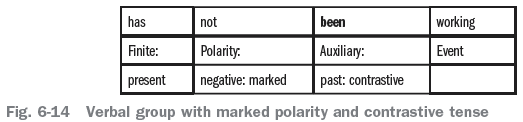
Just as with the nominal group, therefore, there is no call to give a separate analysis corresponding to each of the three semantic components experiential, interpersonal, textual. The textual meaning is embodied in the ordering of the elements. The interpersonal meaning resides in the deictic features associated with finiteness — primary tense or modality — together with any attitudinal colouring that may be present in the lexical verb. And further systematic distinctions of both kinds may be realised by intonation and rhythm: contrast the neutral he hasn’t been working
// ^ he /hasn’t been /working //with a variant such as he has not BEEN working// ^ he has /not /been /working //which has ‘marked negative (polarity)’ and ‘contrastive past (tense)’, as in Figure 6-14.
Interpersonal meanings are embodied (a) in the person system, both as pronouns (person as Thing) and possessive determiners (person as Deictic); (b) in the attitudinal type of Epithet; (c) in connotative meanings of lexical items functioning in the group, and (d) in prosodic features such as swear-words and voice quality.
Interpersonal Epithets also tend to be reinforced by other words, or other features, all contributing to the same meaning: synonyms … , intensifiers, swear–words, particular intonation contours, voice quality features and the like.
As we have seen, many of them may also occur as post-Deictic; in that case their deictic function consists rather in referring to, or even in constructing, an occasion of shared experience as in a miserable few dishes of peanuts. But whereas with adjectives of experiential quality the difference between Epithet and post–Deictic is rather clear (e.g. the three famous musketeers, the famous three musketeers), with the interpersonal ones the difference is much less, and there is no sense of ambiguity in the meaning (contrast those lovely two evenings in Bali and those two lovely evenings in Bali).
The principal difference is that experiential Epithets are potentially defining, whereas interpersonal ones are not. … Even in the superlative …Note that, in general, the same word may act as either experiential or interpersonal Epithet … there are very few words that serve only an attitudinal function.Interpersonal Epithets tend to precede experiential ones.
The Epithet indicates some quality of the subset, e.g. old, long, blue, fast; since qualities are denoted by adjectives, Epithets are often realised by adjectives. … (i) The quality of the subset may be an objective property of the thing itself, construed as a depiction of the experience of the entity that it represents; or (ii) it may be an expression of the speaker’s subjective attitude towards it, e.g. splendid, silly, fantastic. We refer to these as (i) experiential Epithets and (ii) interpersonal, or attitudinal Epithets, respectively. …
There is no hard and fast line between these two; but the former are experiential in function, whereas the latter, expressing the speaker’s attitude, represent an interpersonal element in the meaning of the nominal group (thus contributing to appraisal, in the sense of Martin & White, 2005).
Also found in the post–Deictic position in the nominal group are words expressing the speaker’s attitude (to the thing, or else to the world in general), such as wretched, miserable, lovely, splendid, as in those lovely two evenings in Bali. …The attitude may be focused on the number represented by the Numerative (with a singular determiner a(n) as Deictic and a plural noun as Thing):For a lousy two weeks in New Jersey, you’ll make a shitload of dough.
… circumstances of Quality may also embody positive or negative interpersonal evaluations (e.g. the positively evaluated eloquently), and they may include comparative reference, as with that way, similarly, thus, thus contributing to cohesion in the text.
Within the semiotic domain of attribution, there is one variety of ‘attributive’ clause in which the Attribute denotes a quality of sensing equivalent to the Process of a ‘mental’ clause. … ‘Relational’ clauses with a quality of sensing fall into two types: those which match the like [‘emanating’] type of ‘mental’ clause, with Carrier equivalent to Senser; and those which match the please [‘impinging’] type of ‘mental’ clause, with Carrier equivalent to Phenomenon. … many of the Attributes are evaluative in nature; this type of clause is an important grammatical strategy in the enactment of appraisal.
Verbs of this kind include
- matter, count ‘be important’ …
- suffice ‘be enough’,
- abound ‘be plentiful;
- figure ‘make sense’;
- differ, vary ‘be different, varied’;
- hurt, ache ‘be painful’;
- dominate ‘be dominant’,
- apply ‘be relevant’ …
- do ‘be acceptable, enough’ …
- remain ‘be + still’,
- stink, smell, reek … ‘be smelly’ …
and a number of verbs of negative appraisal, some of them abstract versions of ‘be + smelly’, for example stink, suck …
In the ‘attributive’ mode, an entity has some class ascribed or attributed to it. Structurally, we label this class the Attribute, and the entity to which it is ascribed is the Carrier — the ‘carrier’ of the ‘attribute’. … This type of clause is a resource for characterising entities serving as Carrier; and it is also a central grammatical strategy for assessing by assigning an evaluative Attribute to a Carrier.
We should distinguish from Expletives the individual lexical items (‘swear words’) that may be sprinkled anywhere throughout the discourse and have no grammatical function in the clause (as with bloody in it’s a bloody taxation bloody policy, God).
Note that individual lexical items expressing the speaker’s attitude, when incorporated into the structure of a group (usually a nominal group, like bloody in those bloody mosquitoes), have no grammatical function in the clause.