Monday, 6 May 2019

Phrasal Verbs Of Motion


Halliday & Matthiessen (2014: 414):
As the examples illustrate, verbs of motion are phased temporally to indicate durative motion (‘continue to go’) and spatially to indicate directed motion (‘go’ + direction). With the second type, the verb often denotes some specific manner of motion such as flit and clamber in the examples above; the phrasal verb thus makes it possible to combine manner and direction: verb [manner] + adverb [direction]. Similar patterns are found in languages with ‘serial verb constructions’ and ‘verb compounding’. Direction occurs naturally with motion, of course; but it may also be used as a phasal extension verbs of other kinds, as with direction of perception:
Frodo and Sam gazed out in mingled loathing and wonder on this hateful land.

Blogger Comments:

To be clear, on grammatical criteria, gaze and gaze out serve as behavioural Processes, not mental Processes of perception.  For example, neither affords a Phenomenon — * gaze (out) this hateful land — but instead, like some other behavioural Processes, can take a Location circumstance that indicates the orientation of the behaviour, such as gaze (out) on this hateful land.

Sunday, 5 May 2019

Less Prototypical Phrasal Verbs


Halliday & Matthiessen (2014: 414n):
Note that a number of the items functioning as spatial adverbs can also serve as prepositions; cf. they clambered down and the[y] clambered down the hill. These combinations of verb of motion + adverb of place are less like prototypical phrasal verbs in that the adverb can be treated textually in the same way as a circumstance of Place: down they clambered, it was down that they clambered.

Saturday, 4 May 2019

Phrasal Verbs Classified For Phase

Halliday & Matthiessen (2014: 414, 415):
Where there are agnate pairs of verb ~ verb + adverb, the ‘phrasal’ variant involves a specification of phase, similar to the phasal specifications in Chinese by post-verbs although the English range of options is much more restricted since it involves adverbs rather than verbs. There are three types of phase, temporal, spatial (directional) and resultative: see Table 6-17. These occur with various semantic fields; among these, motion is an important one …

Friday, 3 May 2019

Phrasal/Non-Phrasal Verb Agnation

Halliday & Matthiessen (2014: 414):
In the case of see off and many other phrasal verbs, the phrasal verb is thus not agnate with a non-phrasal counterpart. For example, there is no systemic proportionality such that see is related to see off as sound is to sound off. However, with many verbs, the simple verb is agnate with the combination of verb + adverb, e.g. break ~ break off (‘separate’), kill ~ kill off (‘kill in large numbers, rendering extinct’), take ~ take off (‘remove (clothing)’), beat ~ beat up (‘beat severely, inflicting injury’), drink ~ drink up (‘drink to the last drop’), go ~ go up (‘ascend’), go ~ go on (‘continue going’), although specialised senses may also evolve, as with break off in the sense of ‘abruptly stop talking’, beat up in the sense of ‘drum up support’, and go on in the sense of ‘talk at great length’.

Thursday, 2 May 2019

Phrasal Verbs Realise A Single Process

Halliday & Matthiessen (2014: 413-4, 416):
Experientially, a phrasal verb is a single Process, rather than Process plus circumstantial element. This can be seen from their assignment to process types. For example, the verb see represents a mental process, and so has simple present as its unmarked present tense, as in do you see that sign? (not are you seeing that sign?). But see off is material, and so has present in present: are you seeing your brother off? (not do you see you brother off?, which can only be habitual). The transitivity analysis is therefore as in Figure 6-20.


Wednesday, 1 May 2019

Phrasal Verb: Expansion Of The Event?

Halliday & Matthiessen (2014: 411n):
A major point of difference between the verbal group and the nominal group is that the Event (unlike the Thing) is not the point of departure for the recursive modifying relationship. Hence it does not figure as an element in the notation. It could be argued that a phrasal verb represents an expansion of the Event … But we have not explored this line of approach here.

Tuesday, 30 April 2019

Phrasal Verbs: Types

Halliday & Matthiessen (2014: 413): 
Phrasal verbs are lexical verbs which consist of more than just the verb word itself. They are of two kinds, plus a third which is a combination of the other two:
(i) verb + adverb, e.g. look out ‘unearth, retrieve’
(ii) verb + preposition, e.g. look for ‘seek’
(iii) verb + adverb + preposition, e.g. look out for ‘watch for the presence of’

Monday, 29 April 2019

The Distinction Between ‘Contrastive In Tense’ And ‘Contrastive In Polarity’


Halliday & Matthiessen (2014: 411):
The distinction between ‘contrastive in tense’ and ‘contrastive in polarity’ is realised only if at least one secondary tense is chosen; it is however regarded as systemic in all instances, with ambiguity arising where there is no secondary tense.

Sunday, 28 April 2019

No System Of Mood In The Verbal Group


Halliday & Matthiessen (2014: 411):
There is no system of mood in the verbal group.  If a clause is ‘free: indicative’ or ‘bound: finite’, the verbal group is ‘finite’.  If a clause is either ‘free: imperative’ or ‘bound: non-finite’ the verbal group is ‘non-finite’.  The verbal group of an imperative clause is ‘perfective’ in aspect and ‘no secondary’ or ‘present’ in (secondary) tense; negative variants have the special realisation don’t(In various languages, clausal contrasts in MOOD correlate with verbal contrasts in MODE.

Saturday, 27 April 2019

The Key To The Organisation Of The Verbal Group


Halliday & Matthiessen (2014: 411):
The logical system of SECONDARY TENSE provides the key to the organisation of the verbal group: this is the system that defines the logical structure discussed above. The system of VOICE also contributes an auxiliary to this structure (be ... -en), which functions like a final secondary tense right before the Event.

Friday, 26 April 2019

Verbal Group Systems By Metafunction


Halliday & Matthiessen (2014: 411):
The systems of the verbal group derive from different metafunctions:
(i) Textual: voice, contrast and ellipsis; 
(ii) Interpersonal: polarity, finiteness and modality; 
(iii) Experiential: aspect and event type; 
(iv) Logical: secondary tense.


Thursday, 25 April 2019

Event Type


Halliday & Matthiessen (2014: 410-1):
As we have seen, the verbal group is highly grammaticalised: all elements of its structure except for the Event are realised by grammatical items, the Event being the only one that is realised by a lexical item. It follows that the system network of the verbal group is a network of systems representing contrasts that are purely grammatical in nature.  The only system that extends in delicacy towards distinctions that are realised lexically is the system of event type — the verbal group analogue of the thing type system in the nominal group.  This system is concerned with distinctions among verbs relating to their temporal properties (thus complementing the clausal system of process type, which is concerned with distinctions among processes relating to configurations of process plus participants).

Wednesday, 24 April 2019

Tuesday, 23 April 2019

Serial Tense Subcategorises Events Grammatically

Halliday & Matthiessen (2014: 407):
What has happened is that relative time — before, at or after a defined time reference — has come to be interpreted, in the semantics of English, as a kind of logical relation; a way of subcategorising events similar to the subcategorising of things, except that the latter is multidimensional (and hence lexicalised), whereas the former is based on a single semantic dimension and can therefore be expressed entirely by grammatical means.

Monday, 22 April 2019

Serial Tense Vs 'Aspect' Nomenclature

Halliday & Matthiessen (2014: 406):
What is remarkable about serial tense is its regularity: the way in which each choice of tense, whether past, present or future, defines a location in time which is then used as the point of departure for a further choice among the same three tenses. This regularity is obscured, and distorted, by the categories of the structuralist analysis, and especially the ‘aspect’ nomenclature of perfect and progressive (or continuous).

Sunday, 21 April 2019

Tense System Differences: Deixis


Halliday & Matthiessen (2014: 405):
The difference between this [System III] and System II is that in System III the effect is simply to eliminate the entire choice of primary tense. System I minus the α tense gives System III. The non-finite or modalised verbal group has no deictic tense element: non-finites because they have no deictic at all (that is what non-finite implies: not anchored in the here-and-now); modalised because, while they have a deictic element (being finite), their deixis takes the form of modality and not tense. Strictly speaking, the first secondary tense of the non-finite should be labelled α, since that becomes the Head element; but it seems simpler and clearer to retain the association of α with finiteness and show non-finites as beginning with β.

Saturday, 20 April 2019

Non-Finite Tense Systems (System III)

Halliday & Matthiessen (2014: 405):
System III is the tense system available in non-finite and in modalised forms of the verbal group. Here a further neutralisation takes place, that is, both that in system II (affecting the past) and a parallel one affecting the future. … What happens here is that (i) past, past in present and past in past are all represented by past; (ii) future, future in present and future in future are all represented by future. There are twelve such triads; the total number of tenses in System III is therefore 36 – (2 x 12) = 12.

Friday, 19 April 2019

Sequent Tense Systems (System II)

Halliday & Matthiessen (2014: 404-5):
System II is that which is available after a past projection [i.e. projecting clause] such as they said. … What happens here is that in the environment of a ‘past’ feature, the past element in three of the System II tenses is neutralised; past, past in present and past in past [are] all represented as past in past. Since there are six such triads, System II has 2 x 6 =12 fewer tenses than System I.

Thursday, 18 April 2019

Finite, Sequent & Non-Finite Tense Systems


Halliday & Matthiessen (2014: 404):
There are in fact three distinct systems of tense in English:
  • System I: finite 36 tenses
  • System II: sequent 24 tenses
  • System III: non-finite/modalised 12 tenses

Wednesday, 17 April 2019

Logical Structure Of The Verbal Group: Restrictions On Tense


Halliday & Matthiessen (2014: 401):
Since the tense system is recursive, there should be no longest possible tense.  However, in practice there are certain restrictions which limit the total set of those that occur.  These restrictions, or ‘stop rules’, are as follows:
  • (i) Apart from α, future occurs only once.
  • (ii) Apart from α, present occurs only once, and always at the deepest level.
  • (iii) Apart from α, the same tense does not occur twice consecutively. … 
    That is:
    • following (i), we do not hear she is going to have been about to do it
    • following (ii), we do not hear he has been having done it
    • following (iii), we do not hear they will have had done it.
    These restrictions limit the total number of finite tenses to 36.

    Tuesday, 16 April 2019

    Logical Structure Of The Verbal Group: Voice


    Halliday & Matthiessen (2014: 400):
    The expression of voice is an extension of that of tense.  The active has no explicit marker; the passive is expressed by be or get plus V-en (past/passive participle), appearing as an additional modifying element at the end.  The passive thus functions like an additional secondary tense; and it displays a distinctive combination of presentness (be) and pastness (V-en) suggesting ‘to be in a present condition resulting from a past event’For this reason, there is no very clear line between passives and attributes having passive form.

    Monday, 15 April 2019

    Logical Structure Of The Verbal Group: Primary & Secondary Tense

    Halliday & Matthiessen (2014: 398-9):
    The logical structure of the verbal group realises the system of tense. … Thus tense in English is a recursive system.  The primary tense is that functioning as Head, shown as α.  This is the Deictic tense: past, present or future relative to the speech event.  The modifying elements, at β and beyond, are secondary tenses; they express past, present or future relative to the time selected in the previous tense… In naming the tenses, it is best to work backwards, beginning with the deepest and using the preposition in to express the serial modification.

    Sunday, 14 April 2019

    Verbal Group: Limitations Of Experiential Labelling

    Halliday & Matthiessen (2014: 398):
    However, the structural labelling of the words that make up the verbal group is of limited value, not only because the meaning can be fully represented in terms of grammatical features (of tense, voice, polarity and modality), but also because it is the logical structure that embodies the single most important semantic feature of the English verb, its recursive tense system, and the elements of the logical structure are not in the individual words but certain rather more complex elements.

    Saturday, 13 April 2019

    Verbal Group: Metafunctional Components

    Halliday & Matthiessen (2014: 397-8):
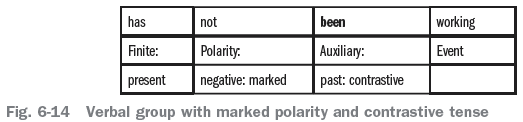
    Just as with the nominal group, therefore, there is no call to give a separate analysis corresponding to each of the three semantic components experiential, interpersonal, textual. The textual meaning is embodied in the ordering of the elements. The interpersonal meaning resides in the deictic features associated with finitenessprimary tense or modality — together with any attitudinal colouring that may be present in the lexical verb. And further systematic distinctions of both kinds may be realised by intonation and rhythm: contrast the neutral he hasn’t been working
    // ^ he /hasn’t been /working //
    with a variant such as he has not BEEN working
    // ^ he has /not /been /working //
    which has ‘marked negative (polarity)’ and ‘contrastive past (tense)’, as in Figure 6-14.
     

    Friday, 12 April 2019

    Verbal Group / Nominal Group Parallelism: Textual Motivation

    Halliday & Matthiessen (2014: 397):
    Initial position is thematic; and the natural theme of a process or participant is its relation to the here-&-now.  Final position is informative; and the newsworthy component of a process or participant is some aspect of its lexical content.  So the structure of groups recapitulates, in the fixed ordering of their elements, the meaning that is incorporated as choice in the message structure of the clause.

    Thursday, 11 April 2019

    Verbal Group / Nominal Group Parallelism: Underlying Commonality

    Halliday & Matthiessen (2014: 397):
    Both verbal and nominal group begin with the element that ‘fixes’ the group in relation to the speech exchange; and both end with the element that specifies the representational content — the difference being that, since things are more highly organised than events, there are additional lexical elements in the nominal but none in the verbal group.

    Wednesday, 10 April 2019

    Verbal Group / Nominal Group Parallelism

    Halliday & Matthiessen (2014: 397):
    A striking feature of this structure is its parallelism with the nominal group. The verbal group begins with the Finite, which is the verbal equivalent of the Deictic, relating the process to the ‘speaker-now’; the Finite does so by tense or modality, whereas the Deictic does so by person or proximity, but each of these provides the orientation of the group. The verbal group ends with the Event, which is the verbal equivalent of the Thing; the former expresses a process, which may be an event, act of consciousness or relation, whereas the latter expresses an entity of some kind, but both represent the core of the lexical meaning.

    Tuesday, 9 April 2019

    Experiential Structure Of The Finite Verbal Group

    Halliday & Matthiessen (2014: 397):
    The experiential structure of the finite verbal group is Finite (standing for ‘Finite operator’) plus Event, with optional elements Auxiliary (one or more) and Polarity. Finite verbal groups range from short, one-word items such as ate, where the Finite is fused with the Event and there is no Auxiliary, to long strings like couldn’t have been going to be being eaten.

    Monday, 8 April 2019

    Verbal Group Viewed From Above And Below

    Halliday & Matthiessen (2014: 396-7):
    The verbal group is the constituent that functions as Finite plus Predicator (or as Predicator alone if there is no Finite element) in the mood structure (clause as exchange); and as Process in the transitivity structure (clause as representation). …
    A verbal group is the expansion of a verb, in the same way that a nominal group is the expansion of a noun; and it consists of a sequence of words of the primary class of verb. If we consider has been eating just as a word sequence, it contains a lexical verb eat, which comes last; a finite verb has, which comes first; and an auxiliary verb been, which comes in between. No other ordering of these three components is possible. 
    As with the nominal group, we can express this both as an experiential and as a logical structure. Because there is very much less lexical material in the verbal group — only one lexical item, in fact — the experiential structure is extremely simple; and most of the semantic load is carried by the logical structure, including the tense system.

    Sunday, 7 April 2019

    Dissociation Of Head & Thing: Construal

    Halliday & Matthiessen (2014: 396):
    In all such nominal expressions where Head and Thing are not conflated although both are clearly present, what is being construed is a phenomenon that from one point of view appears as a single entity and from another point of view as two. Such expressions have their basis in the concrete realms of our experience, such as cups and coffee; they then become an extremely rich resource for construing the virtual entities that make up so much of the environment of our adult existence.

    Saturday, 6 April 2019

    Extended Numerative: Type: Facet


    Halliday & Matthiessen (2014: 395-6):
    In expressions of facet such as the front of the house, the entire length of the narrative, the Head noun front, length is related in function to the preposition in a prepositional phrase: before/in front of the house, throughout the narrative. There is, in fact, a cline from one to the other: for example 
    • at the summit of the hill (where summit is both Head and Thing) – 
    • at/on the top of the hill – 
    • on top of the hill – 
    • (atop the hill —) 
    • on the hill (where hill is both Head and Thing). 
    In on top of the hill, on top of is a preposition group; here top has no Deictic, cannot be pluralised, and can be used with abstract Things (I think we’ve got on top of the problem). But at/on the top of the hill forms a prepositional phrase: the preposition is at or on; the top of the hill is the Complement, where top can be pluralised ((on) the tops of the hills), but not made abstract – we will not find on the top(s) of the problem(s). Here top is a facet term, and the analysis will be as in Figure 6-12.

    Blogger Comments:

    In Figure 6-12, 'Qualifier' (experiential) should be 'Postmodifier' (logical).

    Friday, 5 April 2019

    Extended Numerative: Type: Variety


    Halliday & Matthiessen (2014: 395):
    Those of variety include a few very general terms such as kind, sort, type; these are the expressions that have led to the use of kind of, sort of as little more than markers of hesitation in casual speech. The words example, instance, specimen sometimes function in a similar way, especially in exemplifying identifying clauses, e.g. a toad is an example of an amphibian, whereas with a word like kind the meaning of classification is embodied in the clause structure and is construed by the clause structure even where the classifying word is omitted (a toad is an amphibian).

    Thursday, 4 April 2019

    Extended Numeratives: Measure Vs Type

    Halliday & Matthiessen (2014: 395):
    While measure items [aggregate, portion, quantum] delimit the Thing in terms of quantity, those of type [variety, facet, make-up] delimit it in terms of generality: some species of it, some aspect of it, or its composition.

    Wednesday, 3 April 2019

    Epithet And Head/Thing Dissociation


    Halliday & Matthiessen (2014: 394-5):
    A measure item may be followed by a fully elaborated nominal group, as in a cup of that good strong Indian tea. It often happens that the Epithet is transferred to the Head, as in a strong cup of tea, although clearly it is the tea that is strong, not the cup. Similarly: a bloody good cup of coffee. It is partly the rather ambivalent nature of this structure, in which Head and Thing are separated, that causes this to happen; but it also arises because in many instances the Epithet could apply equally well to either, as in a cloud of thick smoke, a thick cloud of smoke, which provides the model for a strong cup of tea. (Classifiers, on the other hand, do not get transferred; we do not say a brown slice of bread.) Sometimes the Epithet belongs more naturally with the Numerative, as in a large cup of tea; but even here one can never have an Epithet that characterises the item in question in any way other than its function as a Numerative – one cannot say a blue cup of tea to mean ‘a cup of tea in a blue cup’. Finally, it is not unusual to have an Epithet in both positions, as in a thick layer of powdery snow, a plastic cup of red, watery punch.

    Tuesday, 2 April 2019

    Extended Numerative vs Qualifier In Nominal Groups


    Halliday & Matthiessen (2014: 394):
    The word of is the generalised marker of a structural relationship between nominals. All these instances can be related to the different senses of of occurring in a Qualifier; e.g. (aggregate) the House of Lords, (portion) both Houses of Parliament, (quantum) a house full of treasure, (variety) a house of respite, (facet) the House of Windsor, (make-up) a house of three storeys. In all such examples, house is both Head and Thing. In measure/type expressions, on the other hand, the Head word has become partially grammaticalised; hence it is often phonologically weak (non-salient), and there is often indeterminacy about the location of other elements in the nominal group, such as plural markers and Epithets.

    Monday, 1 April 2019

    Dissociation Of Head & Thing: Extended Numeratives

    Halliday & Matthiessen (2014: 393, 394):
    There is one other significant variety of nominal group that is construed in the same way, with the Head dissociated from the Thing and the two linked by of, as in a cup of coffee. We noted above that such expressions often figure as agnate to a ‘counted’ mass noun: a new polish/type of polish, three coffees/cups of coffee. These could be regarded as extended Numeratives, the Head being a word of measure or type. They can be represented as a matrix of two variables (see Table 6-11): (i) measure (quantity) / type (quality), (ii) the set relationship of Head to Thing (collective (Head > Thing), partitive (Head < Thing), quantitative (Head = Thing)). 
    What all these have in common is that, while the Thing is the entity that is functioning as participant in the transitivity structure of the clause, the logical Head of the construction is something that constrains the entity in terms of the two variables mentioned above. It is the Head that determines the value of the entity in the mood system, and therefore as a potential Subject.

    Sunday, 31 March 2019

    The Relationship Between Dissociated Head And Thing


    Halliday & Matthiessen (2014: 393):
    The relationship the Head and the Thing is either (1) an extending one or (2) an enhancing one: see Table 6-10.
    (1) When the Head is conflated with the Deictic or the Numerative, the relationship between the Head and the Thing is an extending one: ‘Head is a subset of Thing’. 
    (2) When the Head is conflated with the Epithet or the Classifier, the relationship between the Head and the Thing is an elaborating one (which is why this type of construction has been called appositive): ‘Head is Thing’.

    Saturday, 30 March 2019

    Dissociation Of Head And Thing: Classifier As Head

    Halliday & Matthiessen (2014: 393):
    This occurs in examples … where the Head word specifies the class to which the Thing is said to belong.
    The concept of an intercolonial exhibition was a new one …Mixer fell into the category of mutt, an English shepherd and something or the other. …

    Friday, 29 March 2019

    Dissociation Of Head And Thing: Epithet As Head

    Halliday & Matthiessen (2014: 393):
    This is a more restricted type in which the Head is almost always an attitudinal noun embodying some positive or more usually negative appraisal. This appraisal may be extended prosodically by adjectives modifying the attitudinal noun. For example:
    I met this feisty, wonderful, paradoxical genius of a woman that I’m nuts about …
    The Chronicle called it ‘a beached whale of a building’.
    he has apparently been an absolute nightmare of a client
    that some thieving bastard of a cop had walked off with his cigarettes
    I had been dragging and pulling and tugging my stupid fool of a brother all the while

    Thursday, 28 March 2019

    Dissociation Of Head And Thing: Numerative As Head

    Halliday & Matthiessen (2014: 392-3):
    This may be cardinative or ordinative, definite or indefinite:
    these two women have always got loads of washing out, loads of tablecloths
    and I think you’ve all four of you given your own subjective reactions to three of these four phenomena
    And it may not be the last of the storms for Washington and the rest of the country.

    Wednesday, 27 March 2019

    Dissociation Of Head And Thing: Deictic As Head

    Halliday & Matthiessen (2014: 392):
    All non-specific Deictics can function as Head in this construction; note that a(n), no, every become one, none, every one, and weak some [sm] becomes someFor example:

    I think we’re seeing another one of those periodic eruptions
    Well, I get rather fed up of some of these youngsters and the claptrap they talk sometimes.
    I can’t offer you any of Malcolm’s sherry because he hasn’t got much.

    Tuesday, 26 March 2019

    Dissociation Of Head And Thing

    Halliday & Matthiessen (2014: 392):
    But there is a further resource in the nominal group that combines these two potentialities, whereby Head and Thing are both present but are dissociated one from the other, not conflated. What happens here is that one of the pre-modifying functions is taken on by something that is itself a nominal group, in such a way that the Thing gets embedded in a prepositional phrase with of, which then functions as post-Head Qualifier, as in a cup of tea (see Figure 6-11). Of course, the two dimensions of structure are both present throughout; what we are showing here is the way the total meaning is construed by mapping the headhood of cup onto the thinghood of tea.
     
    Where the Head is dissociated from the Thing in this way, it can be conflated with any of the premodifying functions. 

    Monday, 25 March 2019

    Premodifier: Word Complexes Vs Word Rank Embeddings

    Halliday & Matthiessen (2014: 392):
    The Premodifier may accommodate both hypotactic word complexes like a very much better argument, and word rank embeddings like a four-post bed, a left-handed batsman; including compressed phrases and clauses like your in-flight magazine, a never-to-be-forgotten experience. The word complexes derive from the potential for logical expansion built into the noun as Head; the embeddings from the functional scope of the experiential configuration into which the noun enters as Thing.
    * In the first two editions of IFG, the Postmodifier also was brought into the scope of the logical representation. But this appears to complicate the description without adding further to its explanatory power.

    Sunday, 24 March 2019

    Head/Thing As Fulcrum

    Halliday & Matthiessen (2014: 392):
    The complex functional entity formed by the conflation of Head and Thing acts as the fulcrum of the nominal group: before it, as Premodifier, a sequence of words having distinct experiential functions; after it, as Postmodifier, one or more embedded items which may be prepositional phrase or non-finite or finite clause.The Premodifier can then be interpreted in logical terms as a hypotactic word complex.

    Saturday, 23 March 2019

    Substitute As Head/Thing


    Halliday & Matthiessen (2014: 391):
    With other Epithets, and with Classifiers, if the Thing is not made explicit it is realised as a substitute one/ones; for example, (he wants) a small one/a wooden one. The substitute is then both Head and Thing, as in Figure 6-10:

    Friday, 22 March 2019

    Epithet As Head

    Halliday & Matthiessen (2014: 391):
    There is one functional environment in which we regularly find Epithet as Head, namely when the nominal group occurs as Attribute, typically in an attributive relational clause. … This type of nominal group (sometimes referred to distinctively as ‘adjectival group’) is unique in that it is normally unable to function as Subject in the clause. … Other than this type, Epithets and Classifiers do not normally function as Head. The exception is the superlative, which in other ways also (for example, place in sequence) resembles a Numerative of the ordering kind rather than an Epithet …

    Thursday, 21 March 2019

    Numerative or Deictic as Head Of Nominal Group

    Halliday & Matthiessen (2014: 390-1):
    We have assumed so far that the Head of the univariate structure is also always the Thing, in the multivariate structure. But this is not so. There is always a Head in the nominal group (unless it is ‘branched’, like one brown in one blue eye and one brown [Ø]); but there may be no Thing. It is quite normal to have Numerative or Deictic as Head, as in Figure 6-9:

    Wednesday, 20 March 2019

    Multivariate Structure [Definition]

    Halliday & Matthiessen (2014: 390):
    By contrast, the type of structure exemplified by Deictic + Numerative + Epithet + Classifier + Thing we call a multivariate structure: a configuration of elements each having a distinct function with respect to the whole.

    Tuesday, 19 March 2019

    Univariate Structure [Definition]


    Halliday & Matthiessen (2014: 390):
    What the logical analysis does is to bring out the hypotactic basis of premodification in the nominal group, which then also explains its penchant for generating long strings of nouns … .  We refer to this kind of structure as a univariate structure, one which is generated as an iteration of the same functional relationship: a is modified by b, which is modified by c, which is … .

    Monday, 18 March 2019

    Premodifier & Postmodifier

    Halliday & Matthiessen (2014: 390):
    The element following the Head is also a modifying element; we can distinguish the two positions by using the terms Premodifier and Postmodifier. The distinction is not a functional one, but depends on the rank of the modifying term; compare a weatherboard shack by the roadside with a roadside shack made out of weather board. These two are not synonymous, but the difference lies in the information structure: the item located at Postmodifier has the greater potential as news. But the Postmodifier does not itself enter into the logical structure, because it is not construed as a word complex.

    Sunday, 17 March 2019

    Sub-Modification (Internal Bracketing): Possible Effects

    Halliday & Matthiessen (2014: 389):
    Within this logical structure there may be ‘sub-modification’: that is, internal bracketing … . Sub-modification may have the effect of disturbing the natural order of elements in the group; this accounts for additional items occurring before the Deictic, as in almost the last buttercup (rather than the almost last buttercup), such a bright moon (rather than a such bright moon), and also for displaced elements, as in not so very difficult a task (instead of a not so very difficult task).

    Saturday, 16 March 2019

    Logical Subcategorisation In The Nominal Group


    Halliday & Matthiessen (2014: 389):
    The basis of the subcategorisation, of course, shifts as we move to the left: ‘what type of ...?’, ‘what quality of ...?’, ‘how many ...?’ and so on – this is the principle underlying the experiential structure. Here, however, we are not concerned with the differences but with the similarities: with the general relationship that runs throughout the pre-Head modification of the nominal group, whatever the experiential function of the individual elements.

    Friday, 15 March 2019

    Nominal Group As A Logical Structure: Modification (Subcategorisation)


    Halliday & Matthiessen (2014: 388-9):
    … seeing [the nominal group] as a logical structure … means seeing how it represents the generalised logical-semantic relations that are encoded in natural language. … for the purposes of the nominal group we need to take account of just one such relationship, that of subcategorisation: ‘a is subset of x’. This has usually been referred to in the grammar of the nominal group as modification

    Thursday, 14 March 2019

    Textual Metafunction & Nominal Group Structure

    Halliday & Matthiessen (2014: 387-8):
    Textual meaning is embodied throughout the entire structure, since it determines the order in which the elements are arranged, as well as patterns of information structure just as in the clause (note for example that the unmarked focus of information in a nominal group is on the word that comes last, not the word that functions as Thing). 
    This means that there is a certain potential for assigning experientially similar meanings different textual statuses within the structure of the nominal group. In particular, they may be presented either as Classifier or as Qualifier (e.g. wooden table ~ table of wood) and as either Deictic or as Qualifier (e.g. my brother’s house ~ house of my brother)*, with the Qualifier having the greater potential as news.
    * And there are further possibilities; for example, Keats wrote A thing of beauty is a joy for ever with of beauty as Qualifier rather than A beautiful thing is a joy for ever with beautiful as Epithet.

    Wednesday, 13 March 2019

    Interpersonal Metafunction & Nominal Group Structure

    Halliday & Matthiessen (2014: 387):
    Interpersonal meanings are embodied (a) in the person system, both as pronouns (person as Thing) and possessive determiners (person as Deictic); (b) in the attitudinal type of Epithet; (c) in connotative meanings of lexical items functioning in the group, and (d) in prosodic features such as swear-words and voice quality.

    Tuesday, 12 March 2019

    Experiential Metafunction & Clause Structure

    Halliday & Matthiessen (2014: 387):
    To complete the triad, first proposed by Pike (1959), of ‘language as particle, wave and field’, the kind of meaning that is expressed in a particle-like manner is the experiential; it is this that gives us our sense of the building blocks of language.

    Monday, 11 March 2019

    Interpersonal Metafunction & Clause Structure

    Halliday & Matthiessen (2014: 387):
    The interpersonal meanings are expressed by the intonation contour; by the ‘Mood’ block, which may be repeated as a tag at the end; and by expressions of modality which may recur throughout the clause. The pattern here is prosodic, ‘field’-like rather than wave-like.

    Sunday, 10 March 2019

    Textual Metafunction & Clause Structure

    Halliday & Matthiessen (2014: 387):
    The textual meaning of the clause is expressed by what is put first (the Theme); by what is phonologically prominent (and tends to be put last — the New, signalled by information focus); and by conjunctions and relatives which if present must occur in initial position. Thus it forms a wave-like pattern of periodicity that is set up by peaks of prominence and boundary markers.

    Saturday, 9 March 2019

    Metafunction & Structure

    Halliday & Matthiessen (2014: 387):
    … it is a general principle of linguistic structure that it is the experiential meaning that most clearly defines constituents. Interpersonal meanings tend to be scattered prosodically throughout the unit; while textual meanings tend to be realised by the order in which things occur, and especially by placing of boundaries. These are very general tendencies, worked out differently in every language but probably discernible in all.

    Friday, 8 March 2019

    Locating 'Thing' In Lexicogrammatical Space


    Halliday & Matthiessen (2014: 386):
    We can use these scales – countability, animacy, generality – as a way of locating the thing in lexicogrammatical space. A fourth factor, that of the metaphoric propensity of nouns (their potential for construing qualities and processes as things). Certain special classes of noun can be identified by reference to the grammar of process types: for example, nouns construing different types of projection. But a more detailed categorisation of things, in terms of their association with roles in the various process types, should emerge after more systematic investigation of the large-scale corpus data that are now available.

    Thursday, 7 March 2019

    Cline Of Generality


    Halliday & Matthiessen (2014: 386):
    On this scale, the most general type of noun is in fact a pronoun, which is the limiting case of anaphoric generalisation … There is no clear grammaticalising towards the ‘particular’ end of the cline, though it is perhaps worth remarking that the function of Classifier in the nominal group provides the resource for expanding any class of thing into more particular subclasses.

    Wednesday, 6 March 2019

    Cline Of Animacy


    Halliday & Matthiessen (2014: 385):
    Here again the grammar makes a categorical distinction: (a) conscious things, which are those referred to as he/she, (b) non-conscious things, those referred to as it. … while there is a clear foundation in the world of experience, with people at one end and inanimate or abstract objects at the other, many things (like non-human animals) lie in between; and, as always, the grammar is free to construe the world as it pleases. 
    The conscious/non-conscious distinction can also therefore be looked at as a cline; and it is one that has received a lot of attention in typological linguistics, under the name of animacy. This, as already remarked, refers to the likelihood of any thing to occur as Actor in a transitive material process, the ‘most animate’ in this sense being, obviously, post-infancy humans.

    Tuesday, 5 March 2019

    Cline Of Countability


    Halliday & Matthiessen (2004: 326):
    Mass nouns representing abstract things, and also things which are concrete but general, often move into the count category: experiences, researches, informations, fruits, furnitures are all relatively recent plural forms. We could think in terms of a cline of countability, ranging from those nouns (and pronouns) which construe things as fully itemised, at one end, to those which treat them as totally unbounded at the other.  Typically, living beings and concrete objects are itemised, abstract entities (and nominalised processes and qualities) are unbounded, with institutions and collectives falling in between.  But the distinction is made in the grammar, so the same entity may be construed in more than one way; e.g. hat(s) ~ headgear, fish(es) ~ fish, novel(s) ~ fiction.

    Monday, 4 March 2019

    Countability


    Halliday & Matthiessen (2014: 385):
    Things are represented in English as either (a) discrete, and therefore countable, or (b) continuous, and therefore uncountable; the grammar thus makes a categorical distinction into count nouns and mass nouns, such that count nouns select for NUMBER: singular/plural, while mass nouns do not. As pointed out above, mass nouns are treated as singular where the deixis is specific, e.g. do you like this poetry/this poem?, and as plural where the deixis is non-specific, e.g. I’ve written some poetry/some poems
    The distinction is not quite as clear-cut as this suggests. Mass nouns are often itemised, and hence also pluralised; the meaning is either ‘a kind of’, as in I’ve found a new polish, or ‘an amount of’, as in three coffees please. There will then be an agnate expression having a measure/type word as Head: a new type of polish, three cups of coffee.

    Sunday, 3 March 2019

    Functional Potential Of Nouns & Pronouns

    Halliday & Matthiessen (2014: 385):
    … we can identify a small number of vectors along which words capable of functioning as Thing are ordered in terms of the grammar, so that the functional potential of any one noun or pronoun will be suggested by its location on each of these vectors. These are:
    1. countability: count/mass
    2. animacy: conscious/non-conscious
    3. generality: general/particular … 
    We can use these scales — countability, animacy, generality — as a way of locating things in lexicogrammatical space.

    Saturday, 2 March 2019

    Common Nouns: The Grammatical Relevance Of Traditional Categories

    Halliday & Matthiessen (2014: 384):
    There is a long tradition of characterising such phenomena, in grammar books, as a list of very general categories, for example ‘persons, other living beings, objects (concrete or abstract), collectives, institutions’. These are relevant grammatically because they relate to a cline of potential agency — that is, the likelihood of functioning as Actor/Agent in the clause; the most likely being persons (human nouns), and the least likely being concrete objects.

    Friday, 1 March 2019

    Common Nouns: Names For Classes Of Things

    Halliday & Matthiessen (2014: 384):
    Common nouns … are nouns that are common (ie generalised) to a class of referents. These name all the classes of phenomena that the language admits as things, and hence as participants in processes of any kind.

    Thursday, 28 February 2019

    Personal Pronoun And Proper Noun

    Halliday & Matthiessen (2014: 384):
    Personal pronouns and proper names are alike in that, for both, the reference is typically unique. With pronouns, the referent is defined interpersonally, by the speech situation. With proper names it is defined experientially: there exists only one, at least in the relevant body of experience. In both cases, this means that typically there is no further specification; pronouns and proper names usually occur without any other elements of the nominal group. Sometimes they need further defining, like you in the back row, Henry the Eighth (this was how surnames started, as Qualifiers of personal names); and they may carry attitudinal Epithets, like poor Tom – cf. pretty little Polly Perkins of Paddington Green, which has both.

    Wednesday, 27 February 2019

    Personal Pronoun As Thing

    Halliday & Matthiessen (2014: 383):
    The personal pronoun represents the world according to the speaker, in the context of a speech exchange. The basic distinction is into speech rôles (I, you) and other rôles (he, she, it, they); there is also the generalised pronoun (one).

    Tuesday, 26 February 2019

    Thing: Realisation

    Halliday & Matthiessen (2014: 383):
    The element we are calling Thing is the semantic core of the nominal group. It may be common noun, proper noun or (personal) pronoun.

    Monday, 25 February 2019

    Qualifier In Incongruent Nominal Groups


    Halliday & Matthiessen (2014: 383):
    In an incongruent nominal group corresponding to a congruent clause, Qualifiers correspond to participants or circumstances in the transitivity structure of the clause; or when the Head/Thing of the nominal group is a nominalisation of a verb of sensing or saying, they may correspond to projected clauses in a clause nexus.
    Carnation has been available in the UK since 1946, but the main marketing effort dates only from 1954 with the removal [of restrictions [on sales] ].
    THE decision [by the Arbitration Commission] [[ to award the 2.3 percent pay increase]] is unfortunate, but it was to be expected.
    This is the real meaning of the US Senate’s decision [last week] [[ to override any possibility of a presidential veto for real, hard-hitting sanctions against the separate, increasingly desperate tribes [[ that make up the political entity of South Africa]] ]] .
    As the examples illustrate, participants reconstrued as Qualifiers are realised by prepositional phrases with either of or by; circumstances are realised in the same way that they would be realised in clauses, by either prepositional phrases or adverbial groups.

    Sunday, 24 February 2019

    Defining Vs Non-Defining Relative Clause

    Halliday & Matthiessen (2014: 383):
    A clause functioning as Qualifier in the nominal group is referred to as a relative clause; more specifically, as a defining relative clause (in contrast to a non-defining relative clause, which is not embedded but hypotactically dependent).

    Saturday, 23 February 2019

    Nominal Group As Qualifier

    Halliday & Matthiessen (2014: 382):
    It is also possible for a nominal group to function as Qualifier inside the structure of another nominal group, for example my brother the lawyer, where the lawyer defines which brother is being referred to. Such instances typically have a possessive determiner as the Deictic element.

    Friday, 22 February 2019

    Qualifier: Nature Of The Characterisation

    Halliday & Matthiessen (2014: 382):
    But the characterisation here is in terms of some process in which the Thing is, directly or indirectly, a participant. It may be a major process — that is, a clause, finite or non-finite; or a minor process — a prepositional phrase. … The non-finite clause may appear in this environment with no verb present, eg the poles with flags on

    Thursday, 21 February 2019

    Qualifier: Function

    Halliday & Matthiessen (2014: 382):
    Like the other, ‘ranking’ (i.e. not embedded) elements of the nominal group, the Qualifier also has the function of characterising the Thing; and again the Deictic the serves to signal that the characteristic in question is defining.

    Wednesday, 20 February 2019

    The Term ‘Embedded’ In SFL

    Halliday & Matthiessen (2014: 382):
    We may also use the term ‘embedded’, taken from formal grammars; but with the proviso that this term is often used to cover both rank shift (where the item is downgraded as a constituent) and hypotaxis (where the item is dependent on another one but is not a constituent of it …). Here we shall use embedded only as an alternative term synonymous with rankshifted.